
Millennials Were Supposed to Fix Work
A 2014 prediction, twelve years of careers-page data, and what worker leverage actually bought us

In the book Overwhelmed, journalist Brigid Schulte writes about her experiences trying to balance work, marriage, and motherhood, and feeling like she’s failing at all of them. It’s a familiar feeling, especially when she talks about the mental load of trying to be both the primary parent and the “ideal worker”.
The myth of the ideal worker goes something like this: the best worker has no distractions. He's fully available, takes few breaks, and has no messy personal life getting in the way. In practice, that worker is usually a man with a partner absorbing the messy life stuff for him—his devotion to work looks effortless because someone else is doing work behind the scenes. Most of us try, and fail, to be him.
Since most of us are probably already aware of this phenomenon, Schulte doesn’t just remind us of the problem; she tries to look for bright spots and find a future where we don’t all have to be ideal workers.
This is how I first heard about Menlo Innovations. In the chapter titled When Work Works, Schulte tours a company where both men and women bring their children to work. They practice pair programming, collaborating on challenging real-world problems while enjoying an environment with supportive colleagues and the flexibility they need to balance their work and their lives.
I learned later that Menlo Innovations is a frequently-cited example of this kind of radical work/life balance. The cofounder and CEO, Richard Sheridan, wrote the book Joy, Inc. about Menlo’s way of working, also trademarked as The Menlo Way. Today, they are still a small technical consulting company with around 50 employees in Ann Arbor, Michigan. From what I can gather, a large part of their business has always been centered on this kind of evangelism: giving tours, writing books, and standing in as an example of what is possible if companies care about their employees’ long-term happiness and stability.

Schulte published Overwhelmed in 2014, and reading it in 2026, I think some of this hits a little bit differently than it was originally intended to. After describing the work environment at Menlo Innovations, she goes on to say: “The way forward is not coming from on high, as people once thought, through government or corporate policy or legislation... It’s the millennials, the roughly eighty million Americans between the ages of eighteen and thirty-five coming into the workforce. Not only does this generation expect time to both work and live well, they’re willing to take their skills and walk or start their own ventures if they don’t get it.”
In other words, maybe work sucks for those of us who don’t work at Menlo Innovations, but fear not—millennials will save us. Millennials have higher standards. We care more about culture, and just by our sheer numbers, we will have the power to influence it. (Fellow millennials, please respond in the comments and tell me whether this worked.)
I’m not here to dunk on Schulte, because honestly, in 2014, I might have said the same thing. I am the first one to admit that I was the millennial who cared about creating a more balanced work environment, and thought that I could write, organize, or influence my way into one.
As I have written about before, I have been working on an AI-assisted data analysis project where I have been using the Wayback Machine to pull in copy from company careers pages and use the OpenAI embeddings API and some Python data analysis tools to quantify the way the language has shifted over time.
The core hypothesis came out of this question: did these “millennial values” influence the workplace, and for how long? How does careers page copy reflect the power that workers have in a given moment?
This week, I took a deeper dive into signals about well-being and care work. What I found wasn’t just a story about millennials, but also about the COVID-19 pandemic, the Great Resignation, and the layoff wave that came later.
First, I went looking for “care language”. Here are a few examples:
“We’ll help you maintain a healthy balance with a gym allowance, parental leave, childcare benefits, flexible work hours, and catered meals to give you more time for the things you care about most.” - Shopify (2015)
“We strive to be a great place to work for people with families.” - Facebook (2016)
“We empower our employees to focus on their families, friends, passions, and Wellbeing.” - Salesforce (2017)
“Our parental leave policy is: ‘take care of your baby and yourself.’ New parents are encouraged to take the time they feel is right.” - Netflix (2018)
On tech company careers pages, this kind of language has been pretty common for a while. But in 2020, its appearance rate nearly quadrupled.
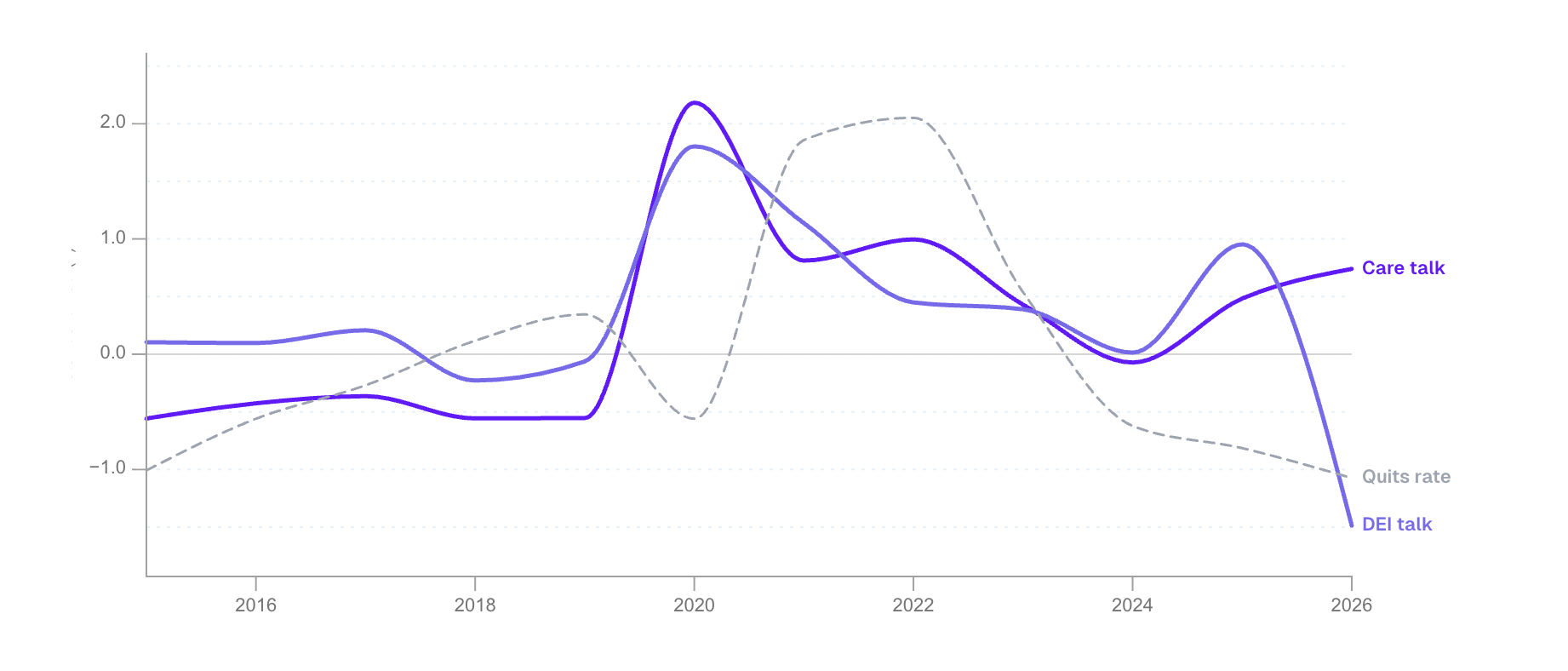
Given the timing, this made sense. We were suddenly thrust into a global pandemic, offices, schools, and childcare centers closed, and employees needed to combine work and home life in a completely new way.
For example, in the early days of the pandemic, my husband and I were working from his parents’ house while waiting to close on our new house in Seattle. I will never forget the day when my husband had to politely ask his father not to walk behind him in a bathrobe while he was on a video call. Work and family had collided in ways that we neither expected nor wished for, and it’s understandable that companies would want to communicate that your life outside of work matters.
The spike didn’t hold, though. Care language peaked in 2020 and has been on the decline. Not quite to the pre-2020 baseline, but far beneath the height of the pandemic.
You may have noticed something else in the chart above, which is that until the recent downturn in DEI-related language, care language and DEI language were very tightly correlated. (If you want to better understand what I mean by DEI language, I elaborated in my previous post.) When you think about it, it makes sense that terms like well-being, belonging, inclusion, family, and caregiving would follow the same millennial-inspired wave.
Of course, the big question isn’t whether companies talk about care and work-life balance; it’s whether they put it into practice. And in the scope of this study of careers pages, I can’t know that. But I can look at the closest thing I have to real action, which is the benefits they describe.
I looked at the kind of benefits that support employees inside and outside of work, such as parental and bereavement leave, fertility and family building, caregiving, lactation support, and identity-positive health care. These benefits have a similar trajectory, but the spike peaks around 2018, and by the pandemic in 2020, it had already started to decline.
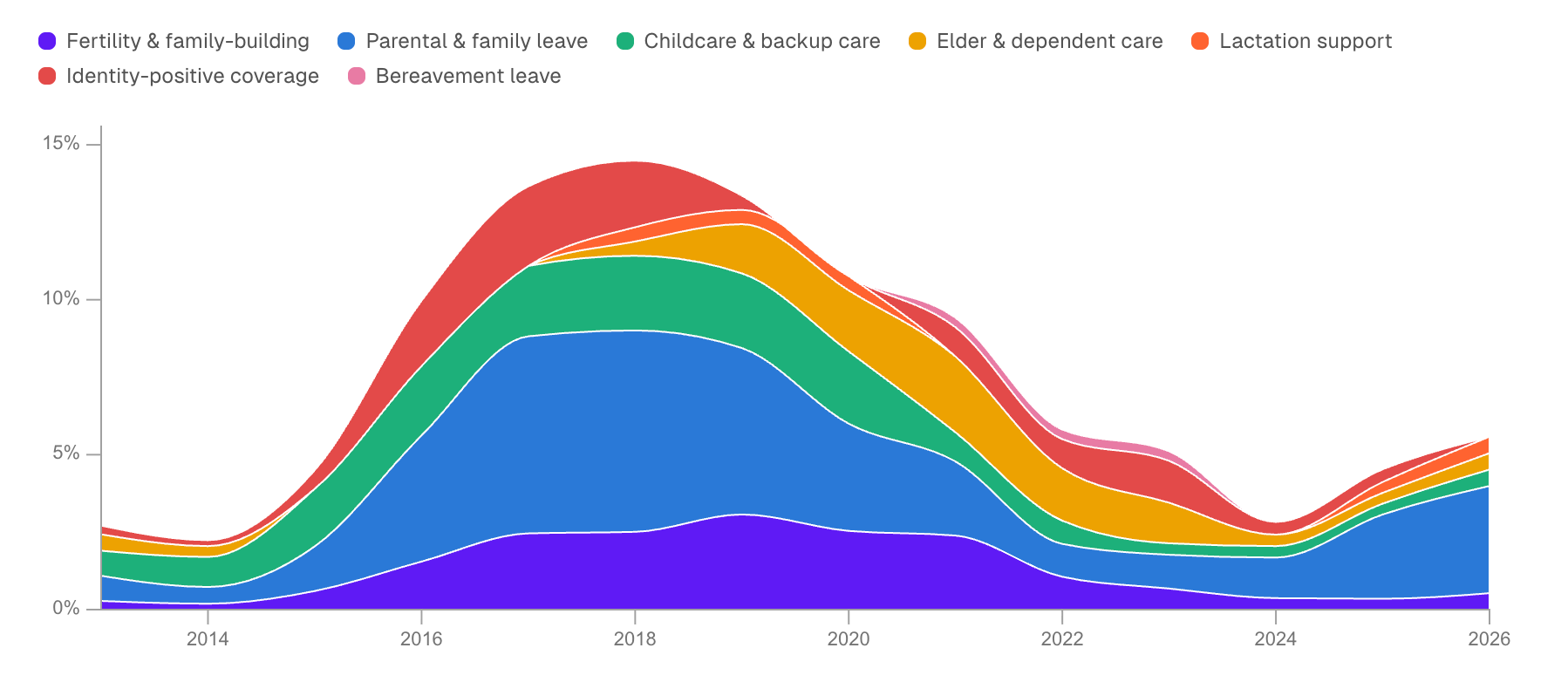
Sit with that timing for a second, because it surprised me. The advertised benefits peaked years before the moment we all remember as peak workplace care. By the time companies were talking the loudest about well-being, the concrete stuff—the leave policies, the caregiving support—was already quietly retreating. The talk and the action weren’t just loosely coupled; they were moving in opposite directions.
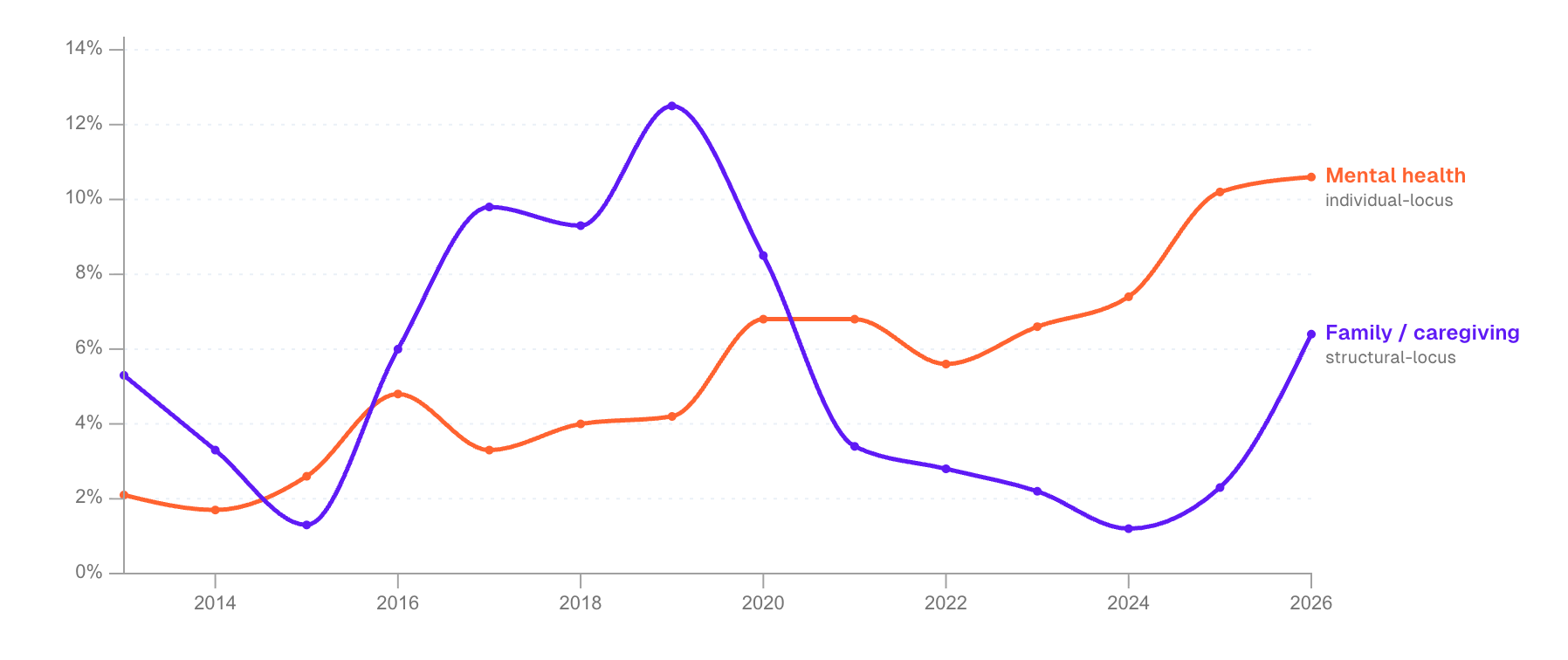
There is one kind of benefit that has been on the rise continually, however, and that is mental health support. This largely includes employee assistance programs, and occasionally app-based mental health services. This makes a sort of cynical sense, because mental health is an individual-level intervention as opposed to a systemic intervention that requires the workplace to adapt. I want to be careful here, because this is the interpretation I am most tempted to believe, and my data on this point is thinner than I’d like. But the pattern fits: when the structural benefits recede, what’s left is a program that asks you to adapt.
Resilience is a Systems Problem

Everywhere I looked, people were talking about resilience. Employers wanted resilient workers. Leaders wanted resilient teams. Articles promised ways to become more resilient through mindfulness, self-care, and stress management. But the more I read, the more I felt like we were asking the wrong question. Resilient groups don’t simply endure disruption — they learn from it, reorganize around it, and change course when circumstances demand it.
So… was Schulte right? I think she was right about this: millennials did have power, at least for a while. But I’ve come to believe her prediction was a little off about what form that power would take. It wasn’t the power to reshape work itself. It was the power to make companies acknowledge that we existed and had somewhere else to go. When I look at the 2020 spike now, I don’t see proof that millennials “won”. I see proof that when workers had options, employers got very good at mimicking our values back at us.
And when that leverage disappeared—when the great resignation cooled, the layoffs began, and the job market tightened—the rhetoric could recede too, because it was never attached to anything structural. The benefits had already peaked in 2016; the only thing that was ever really growing was the band-aid: individual mental health interventions.
Companies like Menlo Innovations are still around. The dream Schulte glimpsed in 2014 wasn’t impossible. It just never scaled—and no generation, it turns out, could make it scale by voting with our feet.
I have tried to put on an analytical mindset for this project, but I don’t think I’ll ever be able to fully separate my interpretation of this data from my own life experiences as an idealistic millennial in the tech industry who has tried for over ten years to figure out how to have both a family and a tech career. I don’t think failure is the word for it, exactly, but many days it does feel like a kind of defeat. When I read predictions about the future of the workplace from the 2010s, I just want to say, me too, I really thought it would be better than this.
📊 If you would like to learn more about my data or methodology, interactive charts and examples can be found here.
Further Reading
A Team, Not a Family

In 2009, Netflix published a slide deck that Sheryl Sandberg called “one of the most important documents to ever come out of Silicon Valley”. The content has been attributed to Reed Hastings, the founder of Netflix, and Patty McCord, Netflix’s Chief Talent Officer from 1998–2012. It outlined their approach to hiring, work culture, and performance.
The Death of "Changing the World"

As a job seeker, I have become a student of tech company careers pages. You know, those pages that always feature photos of smiling employees in matching t-shirts and use enthusiastic language to tell you why you should work there. Most companies use a lot of the real estate on this page to talk about their